Back to: Free Course Lead Magnet Template

Resources and Navigation
Canadian Links
There are fourteen jurisdictions in Canada – one federal, ten provincial, and three territorial each having its own occupational health and safety legislation. For most people in Canada, the agency that you would contact is the provincial or territorial agency in the area where you work.
There is one exception – Federal legislation covers employees of the federal government including Crown agencies and corporations across Canada, regardless of location.
| Jurisdiction | Description | Link |
| Northwest Territories and Nunavut | The Workers’ Safety & Compensation Commission (WSCC) is the Government of the Northwest Territories and the Government of Nunavut Agency that oversees the implementation and application of the Safety Acts and General Safety Regulations, the Mine Health and Safety Acts. | https://www.wscc.nt.ca/ |
| Yukon Territory | The Yukon Workers’ Compensation Health and Safety Board (YWCHSB) is an employer-funded crown corporation responsible for compensating workers with work-related injuries and promoting and enforcing workplace safety. It is the regulator/enforcer of the WHMIS regulations in Yukon | https://www.wcb.yk.ca/ |
| Saskatchewan | In Saskatchewan, the role of education and enforcement for WHMIS and GHS is shared by the partnership of WorkSafe Saskatchewan, a partnership between the Saskatchewan Workers’ Compensation Board (WCB) and the Ministry of Labour Relations and Workplace Safety (LRWS). | https://www.worksafesask.ca/ |
| Alberta | Alberta Labour is responsible to enforce the Alberta Occupational Health and Safety (OHS) Act, Regulation and Code | https://www.alberta.ca/ohs-legislation.aspx |
| Manitoba | Manitoba Labour and Immigration, Workplace Safety and Health administers The Workplace Safety and Health Act and its three associated regulations: The Workplace Safety and Health Regulation, the Operation of Mines Regulation, and the Administrative Penalty Regulation. | https://www.manitoba.ca/labour/safety/index.html |
| Ontario | The Ministry of Labour, Immigration, Training and Skills Development develops and administers Ontario’s legislative and regulatory policy and requirements that implement WHMIS. | https://www.ontario.ca/page/workplace-health-and-safety |
| Quebec | The CNESST provides a single point of contact for workplace-related services in Quebec. The CNESST is the body to which the Government of Quebec has entrusted the administration of the Act respecting occupational health and safety (AROH), and whose purpose is to eliminate hazards to worker health and safety at the source. | https://www.cnesst.gouv.qc.ca/en |
| Newfoundland and Labrador | WorkplaceNL provides no-fault workplace injury insurance to employers and workers across Newfoundland and Labrador under the direction of the Workplace Health, Safety, and Compensation Act (the Act). | https://workplacenl.ca/ |
| New Brunswick | WorkSafeNB is a Crown corporation responsible for the administration and enforcement of New Brunswick’s Occupational Health and Safety Act; Workers’ Compensation Act; Workplace Health, Safety and Compensation Commission Act; and Firefighters’ Compensation Act and corresponding regulations | https://www.worksafenb.ca/ |
| Prince Edward Island | The Workers Compensation Board (WCB) of PEI is an independent, non-profit organization funded entirely by Island employers, providing no-fault workplace injury and illness insurance, and promoting workplace health and safety for all Islanders. | https://www.wcb.pe.ca/ |
| Nova Scotia | Nova Scotia Department of Labour and Advanced Education is responsible for delivering effective and efficient regulatory management for the protection of the health and safety of Nova Scotians | https://novascotia.ca/lae/healthandsafety/ |
| British Columbia | WorkSafeBC is dedicated to promoting workplace health and safety for the workers and employers of British Columbia. WorkSafeBC is charged with administering British Columbia’s Workers’ Compensation Act and enforcing the Occupational Health and Safety Regulation. | https://www.worksafebc.com/en |
| Federal | Federal regulated workplaces fall under the Canada Labour Code and must report to Labour Program. | https://www.canada.ca/en/employment-social-development/services/health-safety/workplace-safety.html |
The Canadian Centre for Occupational Health and Safety (CCOHS) is a Canadian resource centre for workplace safety information. Their website can be found here.
How do I read Legislation?
The Canadian Centre for Occupational Health and Safety (CCOHS) has an excellent fact sheet on how to read the legislation. Follow the fact sheet to understand what is applicable to your company and what is a suggestion/guideline.
Pay special attention to words such as “and”, “may”, “shall”, “must”, “or”, as they can mean very different implications for your business operations.
“Both the Act and Regulations will use specific terms. For example, legal verbs include:
- Shall , Will, or Must– the item or action listed is a requirement
- May or Should – gives choice or option
Another example occurs when a list of items is presented.
(excerpt from CCOHS Fact Sheet)
- And – all items are equal, and all must be followed
- Or – choice is allowed, or only one of the items is necessary for action to be taken”
Your turn!
Try your hand at interpreting this regulation. WorkSafeBC excerpt Occupational Health and Safety Regulation, Part 7, Division 1 – Section 7.9:
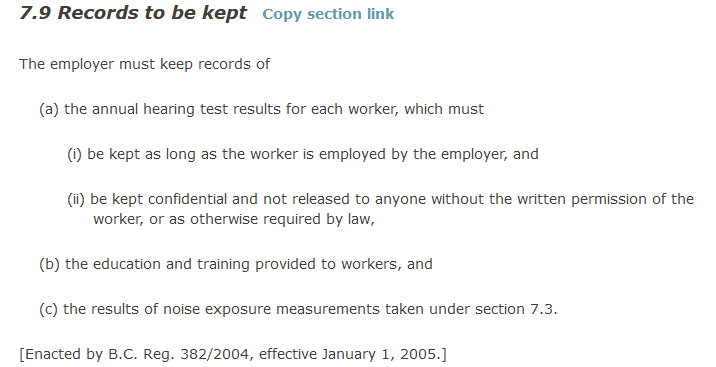
Here are a few questions to help you read the regulation snippet:
Does the employer have to keep records of annual testing or should they?
Yes, they have to keep records. “Must“, “Will” and “Shall” are mandatory requirements
Does the annual test have to be kept as long as the worker is employed?
Yes, same as above.
Can the annual test be released without permission?
No, the test cannot be released without permission. The regulation reads MUST, AND, which are both mandatory, leading to the last subsection to also be mandatory.
Does the employer have to keep records of training or just annual hearing tests?
The employer must keep both, each subsection (a), (b) and (c) are required.
If this starts getting a little confusing, reach out to your local health and safety regulator for questions, or contact us for a short consultation.